Restoration SEO Services Built for Emergency Visibility and Qualified Jobs
Restoration SEO Services improve how restoration companies appear when property owners search for water damage, fire and smoke damage, mold remediation, emergency cleanup, water mitigation, and nearby restoration contractors. A strong strategy connects Google Maps, service pages, real service areas, technical SEO, proof of completed work, AI-search visibility, and lead tracking so urgent search demand becomes jobs the company can actually serve.
Hire Local SEO Services focuses on local and organic visibility for service businesses through Google Business Profile work, technical SEO, content, internal linking, and performance reporting.
Key Takeaways
- Restoration SEO Services should measure qualified emergency jobs, inspections, mitigation projects, and completed restoration work rather than raw calls alone.
- Water damage, fire restoration, mold remediation, and cleaning intent should not be forced into one generic landing page.
- Google currently allows a service-area Business Profile to define up to 20 service areas, while local visibility still depends partly on distance.
- Restoration claims should match real operating capacity, actual certifications, and the services the company can provide at the time of the search.
- IICRC maintains separate standards for professional water damage restoration, mold remediation, and fire and smoke damage restoration.
- Google’s current generative-search guidance says established SEO foundations still apply to AI Overviews and AI Mode.
What Are Restoration SEO Services?
Restoration SEO Services are search optimization services designed for companies that respond to water, fire, smoke, mold, storm, and related property-damage problems. The work combines local SEO, technical SEO, emergency-intent pages, service-area strategy, authority development, and conversion measurement.Restoration search behavior can move fast.
A property owner may follow this path:
Damage event → urgent search → restoration company → call → dispatch
A property manager researching a larger remediation project may follow a longer path through assessment, scope, documentation, and proposal review.The website should support both journeys.A restoration SEO company therefore needs more than a list of keywords. It needs to understand which jobs require immediate response, which services deserve detailed explanation, and which locations technicians can genuinely reach.Traffic is not enough. A qualified restoration opportunity is.
How Should Local SEO Work for Restoration Companies?
Restoration SEO Services for local search should connect the company’s real operating location, genuine service territory, and actual emergency services with nearby searches. Google Business Profile should reflect the real business rather than locations or hours created only for marketing.A restoration local SEO audit should review:
- primary and secondary business categories;
- address eligibility;
- service-area settings;
- phone number;
- emergency hours;
- website URL;
- listed services;
- photos;
- reviews;
- citations;
- location pages;
- local authority.
Google allows up to 20 service areas, but those areas do not override its local ranking framework. Google says local results are primarily based on relevance, distance, and prominence.Restoration companies may travel across large territories after floods, storms, or fires. Website pages can support real operating markets, but Google Business Profile should not imply offices that do not exist.Restoration SEO Services should also verify any “24/7,” “60-minute response,” or similar promise before it appears in titles, headings, or profile content.
How Should Water Restoration Marketing Handle Emergency Search Intent?
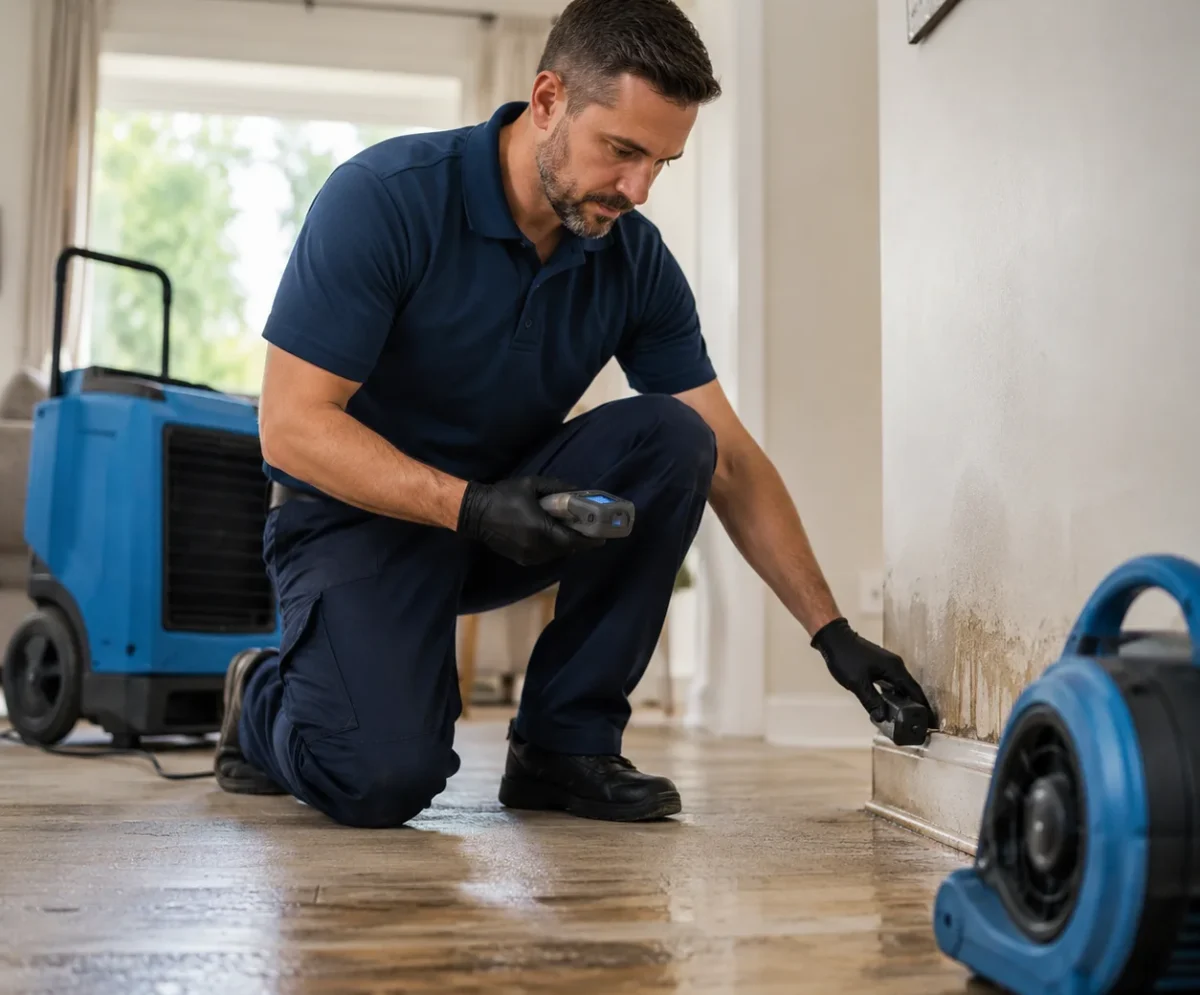
Restoration SEO Services for water damage should make urgent services, real availability, service territory, and the next contact step obvious within seconds. A customer dealing with active water damage should not need to read a long company history before finding the emergency phone number.
Useful page elements include:
- water source or damage scenarios the company handles;
- extraction and mitigation services actually offered;
- verified operating hours;
- service areas;
- clear call action;
- what the customer should expect after contact;
- project evidence;
- relevant qualifications where verified.
IICRC’s S500 standard describes procedures and precautions for professional water damage restoration. Australia also has the current AS-IICRC S500:2025 standard for professional water damage restoration.SEO copy should not claim that every water event has the same contamination category, drying process, or required treatment. The page should explain the company’s process without inventing technical conclusions before inspection.
How Should Fire Restoration Marketing Differ From Water Damage SEO?
Restoration SEO Services for fire damage should target fire, smoke, soot, odor, contents, and structural restoration intent instead of copying a water-damage page and changing a few nouns. Fire losses often create a longer decision process and a wider scope of services.
A fire restoration page can explain:
- emergency stabilization where offered;
- smoke and soot cleanup;
- odor treatment;
- contents handling;
- structural cleaning;
- coordination steps;
- commercial versus residential capabilities;
- reconstruction where genuinely offered.
IICRC lists ANSI/IICRC S700 as its standard for professional fire and smoke damage restoration.That supports treating fire restoration as its own technical discipline. SEO copy should still avoid claims that exceed the company’s credentials or scope.A restoration digital marketing agency should also separate fire-related leads from water-damage leads in reporting. Their urgency, sales cycle, and project value can differ.
How Should Mold Remediation Content Be Written for Search?
Restoration SEO Services for mold remediation should explain moisture control, assessment, remediation scope, and next steps without making unsupported health or treatment claims. The page should help property owners understand the service while staying within the company’s actual qualifications.The U.S. Environmental Protection Agency states that moisture control is central to mold control and advises fixing water problems and drying materials completely. EPA also notes that porous materials may sometimes need removal when mold is present.SEO copy should be careful with statements such as:
- all mold can be cleaned in place;
- our treatment makes the building completely safe;
- one spray permanently prevents mold;
- medical or health guarantees.
IICRC maintains ANSI/IICRC S520 for professional mold remediation.A restoration SEO company should treat technical claims as source-controlled content. The restoration company, qualified remediator, and applicable standards should determine what is publishable.
Should Restoration Companies Create a Page for Every City They Serve?
No. Restoration SEO Services should create a city page only when the market is genuinely serviceable, has meaningful demand, and can support useful local information. Do not publish dozens of emergency pages that only swap the city name.
Use this decision framework:
| Question | Decision Signal |
|---|---|
| Does the company genuinely serve the market? | Required |
| Can crews dispatch there reliably? | Required |
| Is there relevant restoration demand? | Strong reason |
| Can the page contain local proof? | Strong reason |
| Is the page tied to real services? | Required |
| Is it nearly identical to another location page? | Usually do not create |
Useful evidence can include completed projects, response territory, branch information, storm or flood context, and customer feedback.Google warns that using generative AI or other methods to produce large amounts of pages without adding user value may violate its scaled-content-abuse policy.Restoration SEO Services should expand geography only where operations and evidence support it.
What Should a Restoration SEO Company Do Every Month?
Restoration SEO Services should prioritize the current obstacles to qualified emergency and project demand rather than repeat the same content and backlink quota every month. Search Console data, Maps visibility, technical problems, and lead quality should guide the work.
A practical monthly process is:
- Review Search Console. Track water, fire, mold, storm, commercial, and location queries.
- Audit Google Business Profile. Check hours, services, categories, photos, links, and business information.
- Fix technical problems. Address indexation, redirects, duplicates, mobile issues, and Core Web Vitals.
- Improve high-intent service pages. Work first on services closest to revenue.
- Review location pages. Strengthen real markets and remove weak geographic duplication.
- Improve internal links. Connect informational content to emergency and commercial pages.
- Build relevant authority. Pursue legitimate local, industry, supplier, association, and editorial references.
- Measure jobs. Compare traffic with qualified calls, dispatches, inspections, mitigation projects, and revenue.
How Should Restoration SEO Differ Between the USA and Australia?
Restoration SEO in the United States and Australia should use separate terminology, standards references, consumer-language review, service geography, and claims approval. The countries share restoration concepts, but the publishing context is not identical.In the United States, IICRC standards such as S500, S520, and S700 provide industry references for water, mold, and fire/smoke restoration. EPA also publishes official mold and moisture guidance.Australia has a current AS-IICRC S500:2025 standard for professional water damage restoration.Australian Consumer Law also requires service providers to use due care and skill, while businesses must not make false or misleading claims.That matters for statements about guarantees, completion time, damage outcomes, warranties, and service capabilities.SEO teams should not act as legal advisers.Their job is to keep marketing claims tied to approved business information and flag statements that need technical or compliance review.
Frequently Asked Questions
Does SEO work for water restoration companies?
Is water mitigation marketing different from water restoration marketing?
Should fire restoration have a separate page?
Is cleaning SEO the same as restoration SEO?
Can a restoration SEO company guarantee first-place rankings?
Main Services